
A journey through the letters
A footsteps-of-Paul journey through Greece is one of the most rewarding study tours a Christian group can take, because it is the one pilgrimage where the New Testament letters are read in the cities that first received them. Philippians at Philippi. 1 Thessalonians in Thessaloniki. Corinthians at Corinth. The book of Acts is the travel narrative, and the letters are the teaching, and on a Greece journey the two come together in a way that no classroom can reproduce. For a pastor or professor, it is the trip that turns Paul from a name in an epistle into a man on a road.
This leader's guide lays out the standard route, the teaching opportunities at each stop, and the practical decisions that shape a Greece pilgrimage. It is written for group leaders planning a first or return journey and weighing how to build it.
The route: Macedonia to Achaia
Paul's European mission began with a vision — the Macedonian call of Acts 16 — and a crossing of the Aegean. A faithful itinerary follows that path. The journey opens at Neapolis, the modern city of Kavala, where Paul first set foot on European soil. From there the group moves to Philippi, the first city in Europe to hear the gospel, where Lydia was baptized by the river and where Paul and Silas sang at midnight in the prison. The site is extensive and quiet, and the baptistery by the river is a natural place for a group to pause.
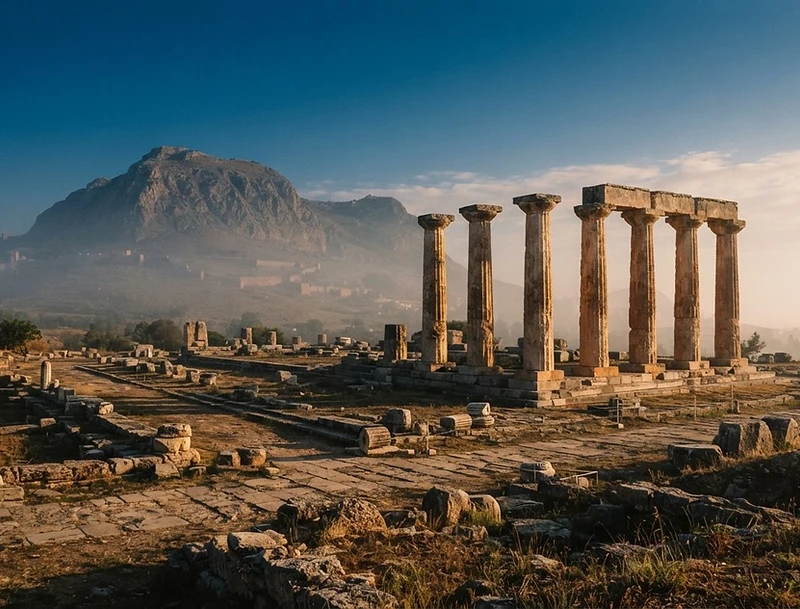
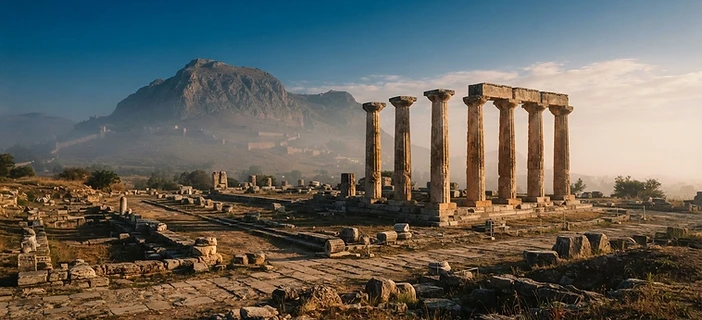
The route continues to Thessaloniki, the thriving port whose young church became an example to all of Macedonia, and to Berea — modern Veria — where the Bereans searched the scriptures daily. Many groups include Meteora at this point, the monasteries built on sandstone pillars, which offers a window into the later Byzantine church and a breathtaking landscape. The journey then turns south to Athens and the Areopagus, where Paul preached to the Unknown God, and finally to Corinth, where he stayed eighteen months and wrote 1 Corinthians.
For groups with time, an extension to Patmos — the island where John received the Revelation — closes the New Testament story with a different voice. The full journey is typically ten to twelve days.

Teaching at each stop
The power of a Greece journey is the alignment of text and place, and the leader's job is to make that alignment explicit. At Philippi, read Acts 16 and the opening of Philippians, and teach on the church that began with a businesswoman and a jailer. At Thessaloniki, read 1 Thessalonians and teach on a young church under pressure. At Berea, read Acts 17:11 and teach on the discipline of testing every word against scripture. At Athens, read the sermon on the Areopagus and teach on engaging a culture of ideas. At Corinth, read 1 Corinthians 13 and teach on love in a divided city.
For a seminary or Bible college, this is a course in Pauline theology taught on site. For a church group, it is a journey through the early church that builds confidence in the New Testament as a record of real events in real places. The teaching plan should be built before the trip, and your operator should build the itinerary around it.
Practical guidance for leaders
Greece is a straightforward destination, but the distances are real. The northern and southern sites are separated by several hours of driving, and we handle the transfers — including the option of a domestic flight or the scenic drive through the interior — so your group is not exhausted. The best seasons are spring and autumn. Summer is hot and busy, and the sites are most crowded then. Plan for two to three nights in the north and three to four in the south, with a single base in Athens for the southern leg.
Group size works best between twenty and forty. The sites in Greece are more spacious than those in Israel, which allows for larger groups, but intimacy still matters for teaching. For travelers with limited mobility, the major sites are largely accessible, though Mars Hill and the Acropolis involve uneven stone and a short climb, and we plan accordingly.
Why a Greece journey after Israel
For groups who have already been to the Holy Land, Greece is the natural next journey. It continues the story — from the life of Christ to the mission of the church — and it does so with a team your group already trusts. Many of our groups plan Israel first and Greece two or three years later, and the combination gives a church a complete picture of the New Testament world.
Why Verity Greece
Verity Greece opens this story to church groups, universities, and seminaries with the same leader-first model we use in Israel. Our guides know the text and the archaeology, and our team handles every detail of travel in Greece so you can lead. If you are planning a first journey or a return trip, we would be glad to build it with you.
Frequently asked questions
How many days does a Greece pilgrimage need? Ten to twelve days for the full route from Macedonia to Corinth. A shorter Athens-and-Corinth-only trip is possible in five to seven days, but the northern sites — Philippi and Thessaloniki — are the emotional heart of the journey.
Do we need to fly within Greece? Not usually. The drive from north to south is scenic and manageable, though for groups short on time a domestic flight between Thessaloniki and Athens is an option we can arrange.
Is Greece a good first pilgrimage? It can be, but for most groups Israel is the better first journey. Greece is the natural next step after the Holy Land, continuing the story from the life of Christ to the mission of the church.
Can we extend to Patmos? Yes. An optional Aegean extension to Patmos — the island where John received the Revelation — closes the New Testament story with a different voice. It adds two to three days and is best scheduled in the calmer seas of late spring through early autumn.