
The church that outlasted an empire
Italy is the destination where the early church met the power of Rome and outlasted it, and for a Christian group that has walked the Holy Land and followed Paul through Greece, it is the journey that completes the picture of how the faith was handed down. Paul arrived in Italy as a prisoner and wrote letters that still shape the church. Believers worshipped underground in the catacombs. Later, movements like that of Francis of Assisi called the church back to simple devotion. A faith journey through Italy is a study in two thousand years of witness, set in some of the most beautiful country on earth.
This white paper lays out the case for a Christian Italy pilgrimage, the standard route, and the teaching that makes it more than tourism. It is written for pastors, professors, and ministry leaders planning a first or return journey.
Why Italy for a Christian group
Italy is the third destination in the Verity family, and it answers a different question from Israel and Greece. Israel is the land of the text. Greece is the land of the letters. Italy is the land of the church — its suffering, its endurance, and its renewal. For a group interested in church history, in the cost of discipleship, and in how the faith was transmitted across the centuries, there is no richer destination.
For evangelical and Protestant groups, Italy is especially valuable because it tells a story that is often under-told: that the church in the centuries after the apostles was a suffering, underground community, and that movements of renewal — of which Francis is the most beloved example — repeatedly called the church back to the words of Jesus. A pilgrimage here is not a tour of Catholic sites; it is a walk through the long, complicated, faithful story of the people of God in the heart of the ancient world.
The route: the Bay of Naples to Assisi
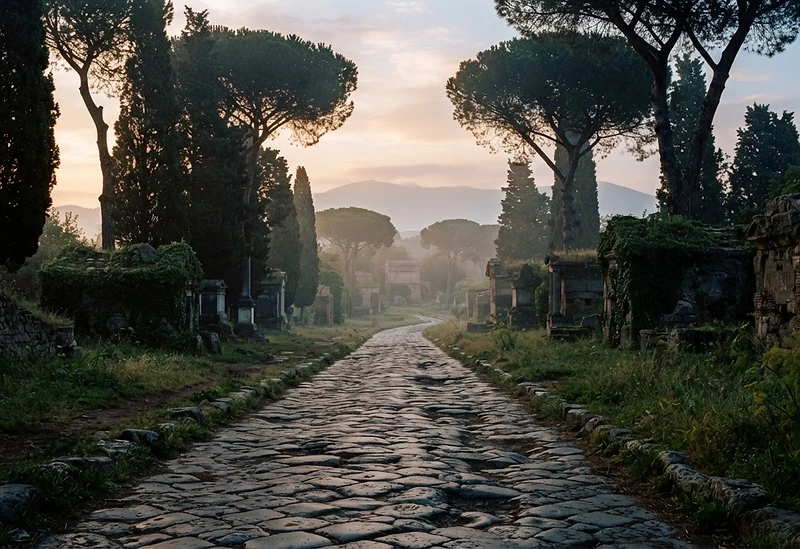
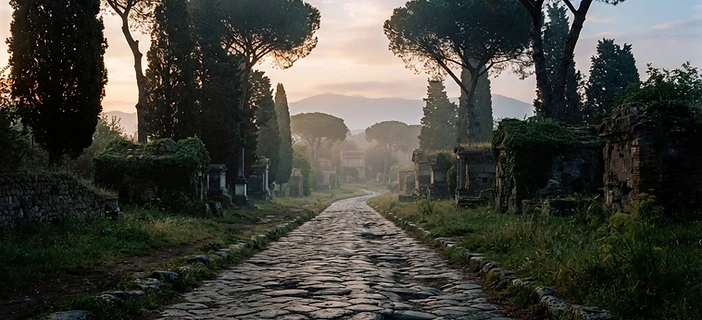
A faithful Italy itinerary follows Paul's arrival and then the long arc of the church. The journey opens at Puteoli, on the Bay of Naples, where Paul landed after the shipwreck on Malta. From there the group follows the ancient Appian Way — the road Paul walked toward Rome — with a stop at the Forum of Appius, where believers from Rome came out to meet him and he took courage. Monte Cassino, the great abbey on the heights above the road, is a natural stop.
The journey then enters Rome for its core. The Roman Forum, the Mamertine Prison (the cell remembered as Paul's final place of confinement), the Colosseum, and the catacombs along the Appian Way tell the story of the church under pressure. For groups with time, the extension to Assisi in the Umbrian hills is the closing movement: the town of Francis, who took the Gospel at its word and renewed the medieval church.
The standard itinerary is eight to ten days, with the option to extend to Florence for groups interested in the Renaissance and the art of faith.
Teaching at each stop
The teaching in Italy is a study in endurance and renewal. At Puteoli and the Forum of Appius, read Acts 28 and teach on the encouragement of the saints. At the Mamertine Prison, read 2 Timothy 4 and teach on finishing well. At the Colosseum and the catacombs, read the texts of suffering and hope — Hebrews 12, the cloud of witnesses — and teach on the church under pressure. At Assisi, read Matthew 19 and the Sermon on the Mount and teach on renewal and the cost of obedience.
For a seminary or church-history group, Italy is a course in the post-apostolic church taught on site. For a church group, it is a journey through the cost and continuity of the faith that builds gratitude and resolve.
Practical guidance for leaders
Italy is the most logistically complex of the three Verity destinations, because Rome is a major capital and the sites are spread across the city and the region. We handle the logistics — tickets, transfers, timing, and the management of crowded sites — so your group moves smoothly. The best seasons are spring and autumn. Summer in Rome is very hot and very crowded. Plan three to four nights in Rome and one to two in Assisi.
For travelers with limited mobility, the major Roman sites are largely accessible, though the catacombs involve stairs and narrow passages, and Assisi is hilly with cobbled streets. We plan routes carefully and allow time.
Why Verity Italy
Verity Italy is opening now, and leaders who join early help shape the first itineraries and get first choice of dates. We bring the same leader-first model we use in Israel and Greece: guides who know the history and the faith, and a team that handles every detail. If you are planning a first faith journey to Italy, a return trip after Israel or Greece, or a leadership retreat, we would be glad to build it with you.
Frequently asked questions
How many days does an Italy pilgrimage need? Eight to ten days covers the Bay of Naples, Rome, and Assisi. Groups with time can extend to Florence for the art of faith. Rome alone deserves three to four nights.
Is Italy only for Catholic groups? No. Italy tells the story of the early church's suffering and endurance, and of movements like Francis that called the church back to the text. We frame the journey for evangelical and Protestant groups as well as Catholic ones.
Should we pair Italy with another destination? Italy works well as a third journey after Israel and Greece, completing the picture of the New Testament world. It also stands alone for groups focused on church history and renewal.
What is the route from Rome to Assisi? About two hours north by road, usually built as a one- or two-night stop after Rome. We travel through the Umbrian hills, with an optional visit to Monte Cassino, the great abbey on the heights above the Appian Way, along the way.